Week 3 / Day 4
Day 4 of 5, 15 min
Cards are for facts
Flashcards are excellent at one narrow job and terrible at everything else. Most people use them for everything else.
Flashcards feel like the responsible choice. You make a deck, the app schedules it, you do your reviews, and it looks like serious studying. Then the exam asks you why something happens, and the deck has not prepared you for that at all.
The cards were not the problem. What you put on them was.
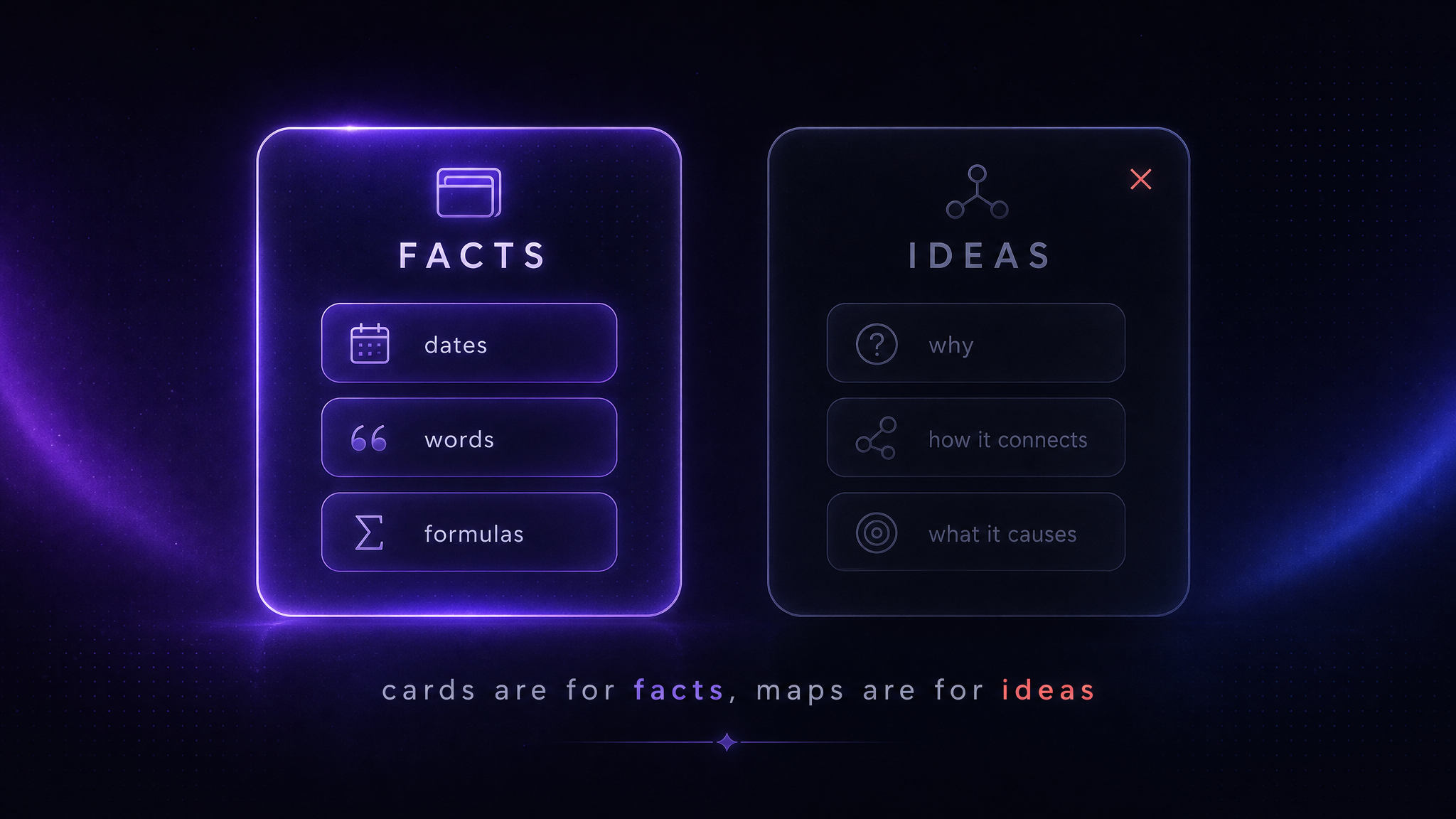
A last resort, used deliberately
Memorising by repetition is a tool of last resort, not a default. It is genuinely good for discrete facts that have no deeper logic to understand: dates, vocabulary, names, formulas, lists. Things that simply are what they are.
It is the wrong tool for anything conceptual. If a thing has a because behind it, a card hides the because. Those belong in the kind of map you built in Week 2, where you can see what causes what and how the pieces hang together.
Watch someone do it
A student had two hundred cards covering an entire module, including the conceptual parts, and still could not answer an essay question. She cut the deck down to about forty: definitions, dates and formulas only. Everything else moved onto one map. The deck now takes five minutes a day and the map is where the actual thinking happens.
Split your material in two
Take one topic and go through it with a single question for each piece: does this have a why behind it? Everything with a why goes in one pile, for mapping. Everything genuinely arbitrary goes in the other pile, for cards. Be honest, because the tempting move is to call something a fact just so you can avoid understanding it.
Ask your own coach
Paste your work into ChatGPT with this. It plays the coach we designed, and pushes on your thinking instead of handing you the answer.
You are my learning coach, trained on the iCanStudy method by Justin Sung. For [topic] I split my material into things I plan to put on flashcards: [paste] and things I plan to map: [paste]. Tell me whether anything in my flashcard pile actually has a why behind it and should be mapped instead, and what I would lose by leaving it on a card. Keep it under 120 words, specific, and encouraging.