Week 3 / Day 5
Day 5 of 5, 20 min
Build your week
Everything from this week becomes one repeatable rhythm you can run on real subjects, in a normal week, without heroics.
You now have the pieces. Testing yourself to hunt gaps, the blank page, widening gaps, and cards kept in their lane. What decides whether any of it survives contact with a real term is whether it has a slot in your actual week.
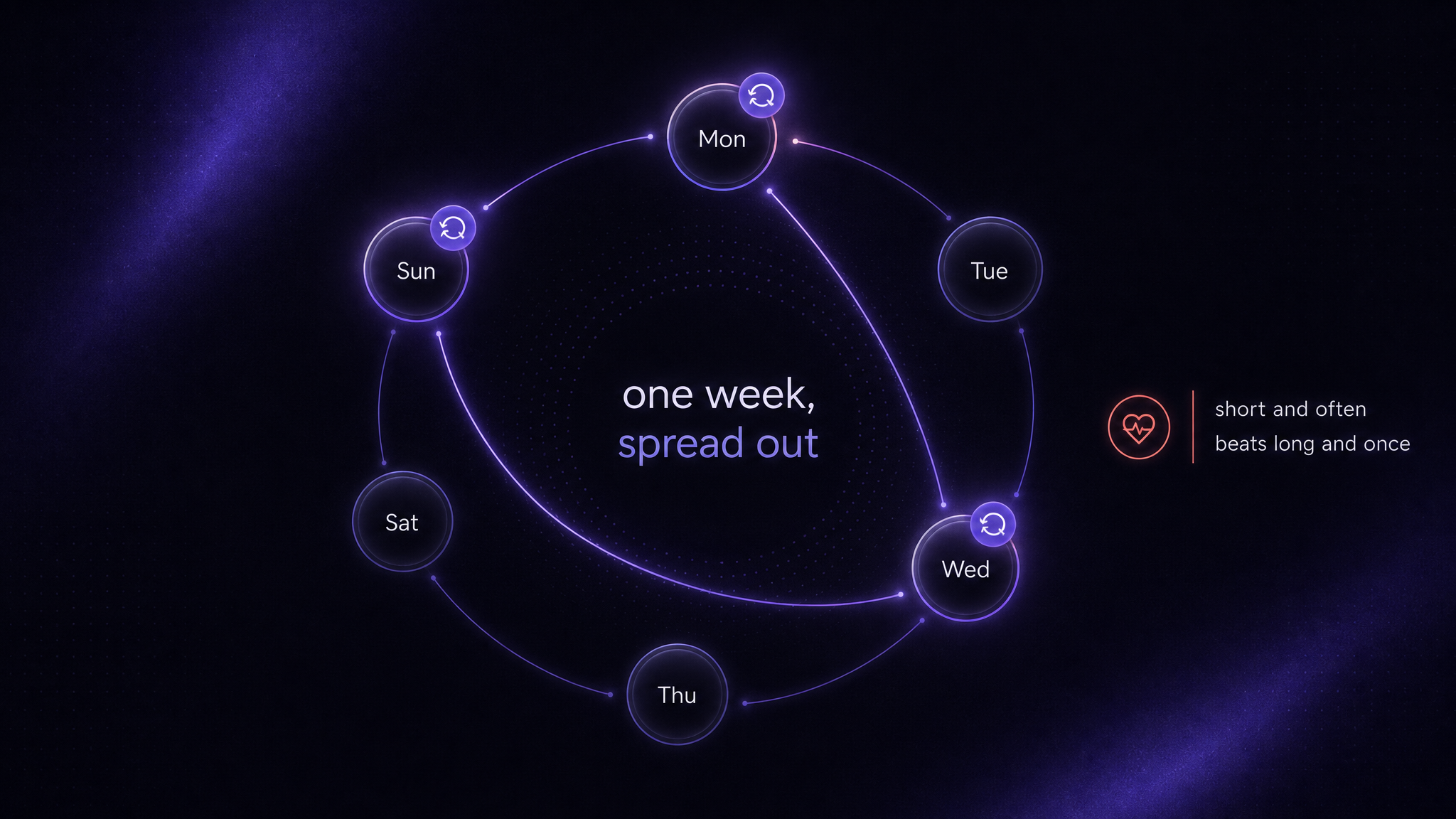
Short, spread out, and boring on purpose
A workable week looks like this. New material gets a quick retrieval pass the same day, ten minutes, notes closed. A couple of days later, the topics from earlier in the week get a short revisit. Once a week, one slightly longer session goes back over everything from the past few weeks, which is where the widening gaps get honoured.
That is it. It is deliberately unglamorous, and it is designed to be small enough that a bad week does not kill it.
Watch someone do it
A student blocks fifteen minutes after each class day for a closed notes recall of what was covered, and one forty minute slot on Saturday morning for everything from the past three weeks. During exam season she does not cram, because her Saturday slot has already been doing it slowly for two months. Her total hours are lower than her friends and her results are not.
Write the actual slots
Write your rhythm down with real days and real times, not intentions. Which days get the ten minute same-day pass, which day gets the midweek revisit, and which slot is your weekly catch-up session. Then run the first one today, on the topic you have been carrying through this week.
Ask your own coach
Paste your work into ChatGPT with this. It plays the coach we designed, and pushes on your thinking instead of handing you the answer.
You are my learning coach, trained on the iCanStudy method by Justin Sung. Here is the weekly retrieval rhythm I have written: [paste your slots]. My real commitments are [paste]. Tell me whether this is realistic or too ambitious, which single slot I should protect above all the others, and what to cut first on a bad week. Keep it under 120 words, specific, and encouraging.