Week 3 / Day 3
Day 3 of 5, 18 min
Widening gaps
Reviewing something five times in one night does almost nothing. The same five reviews, spread out and stretched, change everything.
Cramming works, briefly. That is the problem with it. It gets you through tomorrow and leaves almost nothing behind by the following month, which means every exam season you are relearning things you already paid for once.
The fix is not more hours. It is the same hours, placed differently.
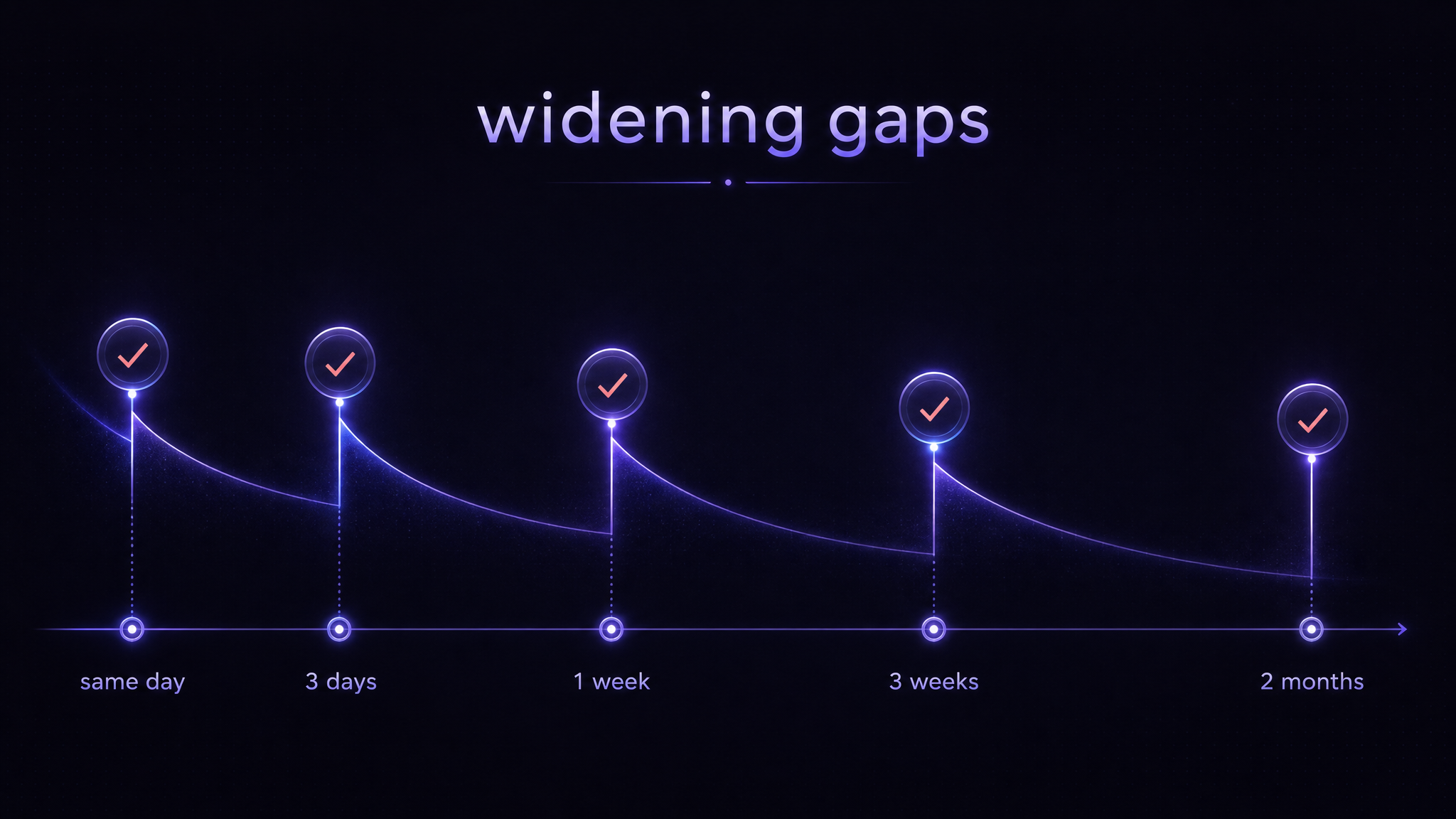
Stretch the gap to the edge of forgetting
The spacing interval is simply the gap between one retrieval session and the next. Cramming puts those sessions minutes apart, which is why it feels easy and fades fast. Spacing pushes them apart on purpose.
A workable rhythm is: review it within a day, then within a few days, then within a week, then within a month. Each gap is longer than the one before, so you are always reviewing just before you would have forgotten. That moment of nearly-forgetting is difficult, and the difficulty is exactly what makes it work.
Watch someone do it
A student finishes a topic on Monday. She revisits it for ten minutes that evening, again on Thursday, again the following weekend, and once more three weeks later. Total time spent is under an hour, spread across a month. A friend spends the same hour on it in one Sunday session. By the exam she still has it and he is starting again.
Put three reviews in your calendar
Take the topic you blurted yesterday. Schedule three short revisits, right now, in whatever you actually use: tonight or tomorrow, then about three days later, then about a week after that. Ten minutes each, and each one is retrieval with the notes closed, not rereading.
Ask your own coach
Paste your work into ChatGPT with this. It plays the coach we designed, and pushes on your thinking instead of handing you the answer.
You are my learning coach, trained on the iCanStudy method by Justin Sung. Here is my review schedule for [topic]: [paste your dates]. My exam or deadline is [date]. Tell me whether my gaps are sensibly spaced or too bunched together, what to change, and how I should tell if a gap was too short or too long. Keep it under 120 words, specific, and encouraging.