Week 1 / Day 4
Day 4 of 5, 20 min
Shallow versus deep
The same ten words can be unmemorable or obvious. The difference is how deeply you process them.
Read these ten words once, then look away and try to list them: habit, spacing, cortex, cue, schema, recall, load, chunk, decay, retrieval. Most people get five or six, and it feels like tyres spinning in mud, lots of effort, no grip.
Now watch what happens when you stop trying to memorise them and start doing something with them instead.
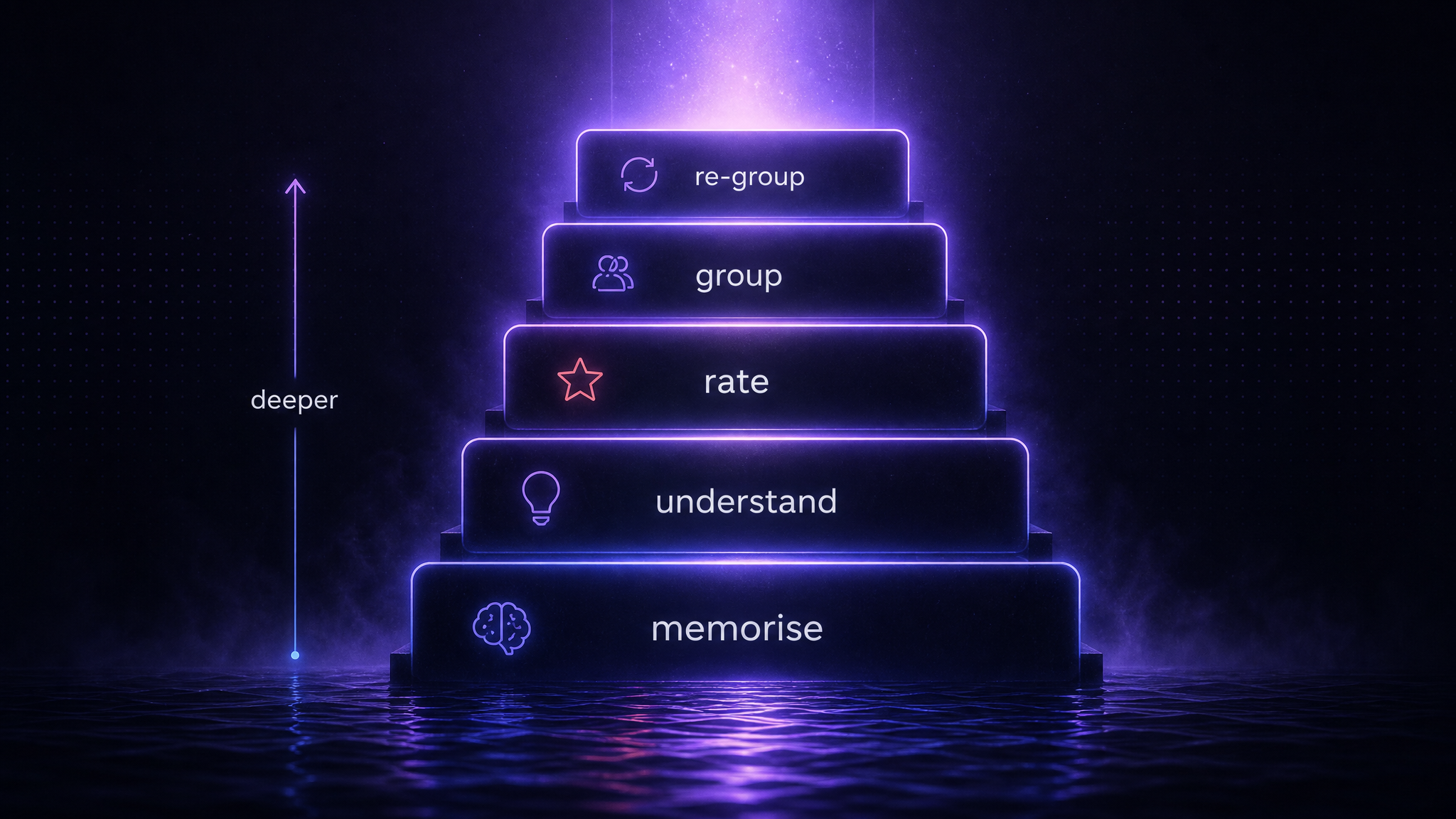
Five levels of processing
How well something sticks depends on how deeply you process it, not how many times you see it. There is a ladder. The bottom rungs feel productive but barely work. The top rungs feel harder and work far better. Tap through them.
Watch someone do it
Faced with twenty new terms for an exam, one student makes flashcards and grinds them. Another spends the first ten minutes just grouping the terms into four themes and naming each theme, then studies inside that structure. The second one needs far fewer repetitions, because the terms now hang off a frame instead of floating loose. Same twenty terms, a fraction of the effort.
Rate, then group
Take eight to ten keywords from a subject you are studying. First, rate each one one-to-five for how important it is. Then group them into three or four groups, and give each group a simple name.
Ask your own coach
Paste your work into ChatGPT with this. It plays the coach we designed, and pushes on your thinking instead of handing you the answer.
You are my learning coach, trained on the iCanStudy method by Justin Sung. Here are keywords from [subject] and how I grouped and labelled them: [paste]. Do not regroup them for me. Tell me whether my groups are meaningful or a bit arbitrary, whether any group has more than four items, and ask me one question that would sharpen my grouping. Keep it under 120 words, specific, and encouraging.