Week 1 / Day 3
Day 3 of 5, 18 min
Why you forget, and what to do about it
Forgetting is not a fault. It is your brain pruning. Here is the shape of it, and how to play it.
Forgetting feels like failure. It is not. Your brain forgets on purpose. It is constantly deciding what is worth keeping, and by default it throws out almost everything, because most of what comes in genuinely does not matter.
So the goal is not to never forget. It is to convince your brain that this thing is worth keeping, and to catch it just before it slips. There is a shape to how forgetting works, and once you see it, you can play it.
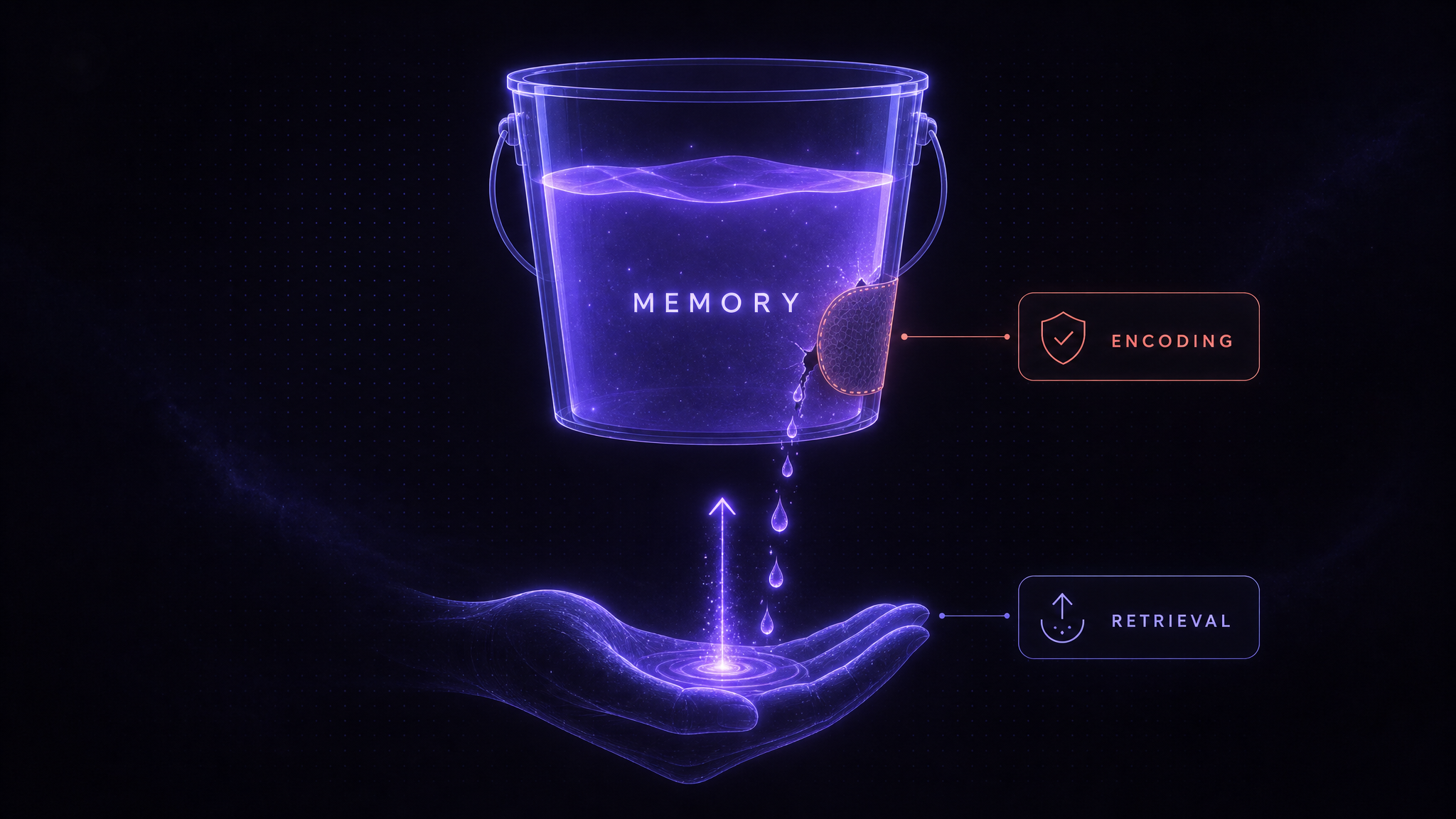
The forgetting curve, and the two halves of memory
When you learn something, you start forgetting it almost right away, fast at first, then slower. That is the forgetting curve. But every time you pull it back out of memory, just before it fades, the curve resets higher and drops off more slowly. Do that a few times at widening gaps and it barely moves.
Two words to keep straight. Encoding is getting something in properly the first time. Retrieval is getting it back out. Most studying is a leaky bucket, you keep refilling what already drained. Encoding plugs the hole. Add the reviews below and watch the curve change.
Watch someone do it
Two students learn the same module. One crams it the night before, gets it in, and it is mostly gone a week after the exam. The other revisits it the same day, then a few days later, then a week later, ten minutes each time. By the exam she has barely reviewed for longer than he crammed, and she still has it a month on. Same effort, spread differently. That is the whole trick.
Book three reviews
Take one thing you learned today. Put three quick reviews in your calendar or notes app: later today, in three days, and next weekend. Ten minutes each, book closed, recall first.
Ask your own coach
Paste your work into ChatGPT with this. It plays the coach we designed, and pushes on your thinking instead of handing you the answer.
You are my learning coach, trained on the iCanStudy method by Justin Sung. I want to remember [topic] for [exam or goal] in [timeframe]. Suggest a simple spaced review schedule with widening gaps, and tell me what to do in each review so I am recalling and not just rereading. Keep it under 120 words, specific, and encouraging.