Week 1 / Day 2
Day 2 of 5, 18 min
What is actually happening in there
You put hours in and results come out. Today we look at the bit in between, because that is where all the leverage is.
You put hours in at one end. Grades and skills come out the other end. But what actually happens in the middle, inside your head, while you are studying? Most people never look. They just add more hours and hope.
That middle bit is not a mystery you have to accept. It has parts, and the parts are yours to control. Once you can see them, studying stops being luck.
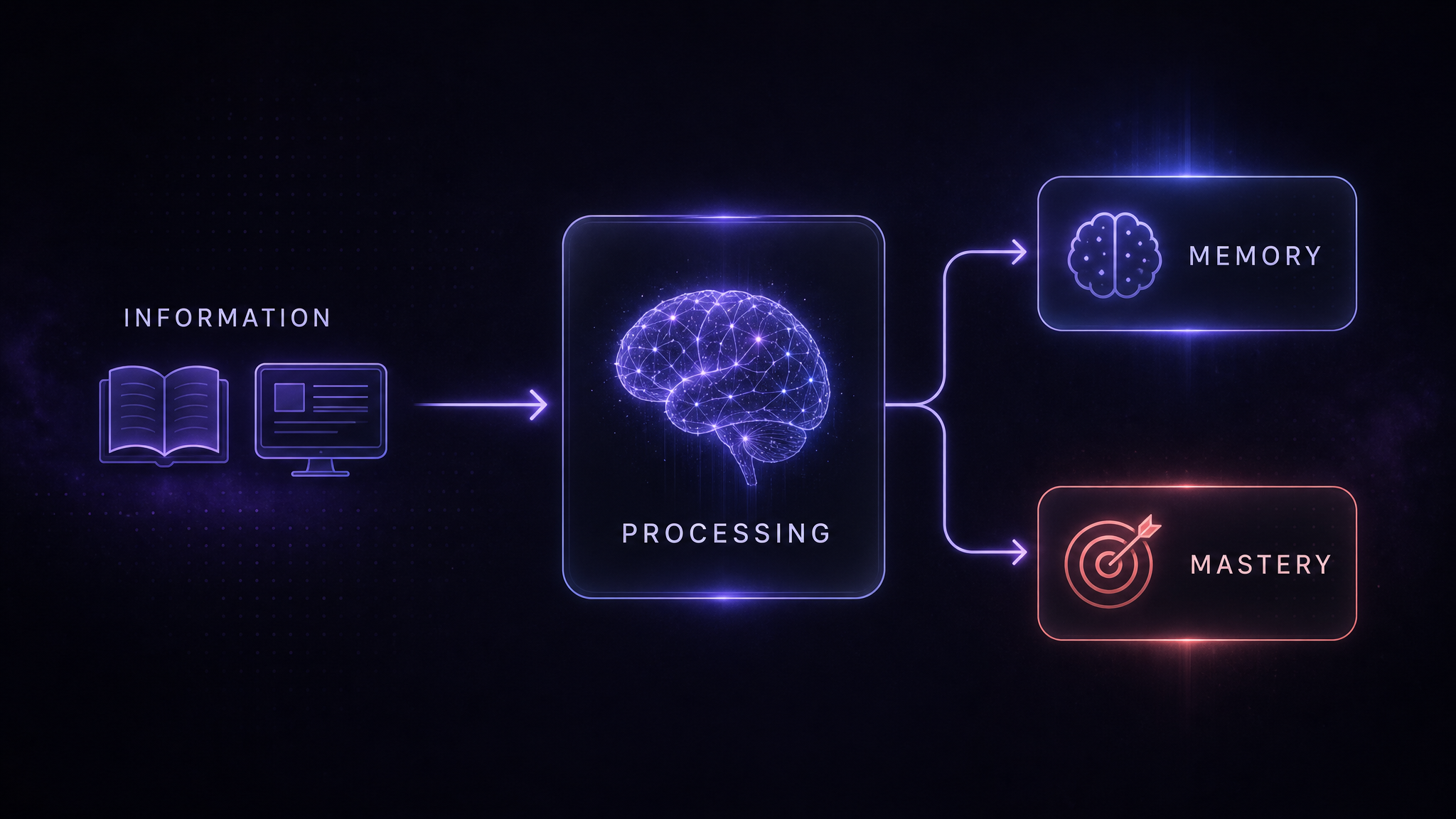
Information in, something happens, memory and skill out
Learning has three parts. Information comes in, from a lecture, a book, a video. Your brain processes it. And out come two things: memory, how much you keep, and mastery, how well you can actually use it. There is a line worth remembering: memory is the residue of thought. You keep what you actually thought about.
Watch someone do it
Two people study the same material. One reads it and moves on, trusting they will remember. The other keeps stopping to ask: how does this connect to what I already know, where would this break, what is this really an example of. Same input, completely different processing. Months later the second one looks like the smarter of the two. She was not born smarter. She just processed deeper, every time.
One connection
Take one thing you read or heard today. In a sentence, write how it connects to something you already know. Not a summary, a connection. "This is like..." or "This is the opposite of..." or "This explains why...".
Ask your own coach
Paste your work into ChatGPT with this. It plays the coach we designed, and pushes on your thinking instead of handing you the answer.
You are my learning coach, trained on the iCanStudy method by Justin Sung. I connected [idea] to [thing I know] like this: [paste]. Tell me whether that connection is genuine or a bit surface-level, and give me one deeper or more surprising connection I could have made. Keep it under 120 words, specific, and encouraging.